SDR Based Waveform (BPSK/QPSK/8PSK/OQPSK)
Overview
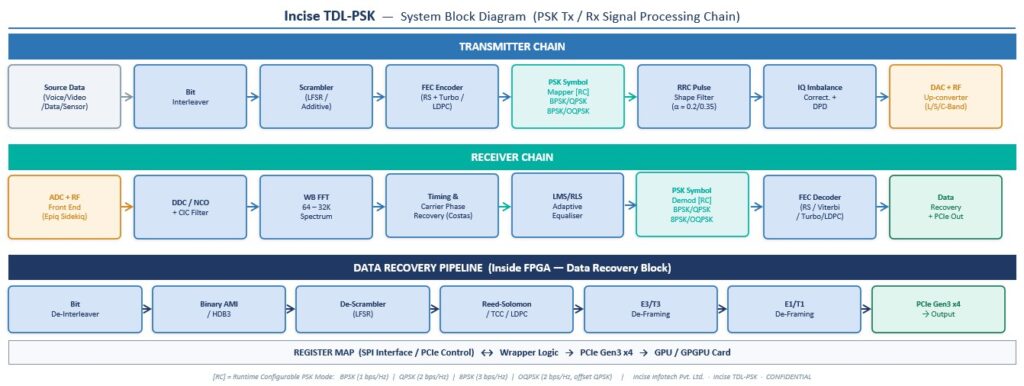
The PSK waveform is a software-defined radio (SDR) based waveform implementing both the transmitter and continuous-mode receiver for BPSK, QPSK, 8PSK and OQPSK modulations. The VHDL IP core is written in generic, synthesizable VHDL and is portable to any FPGA family.
The waveform is implemented on FPGA:
2. Receiver (Rx): Demodulator and Decoder chain with digital AGC, DDC/NCO, RRC matched filter (20/25/40 % rolloff), Costas PLL,
Gardner symbol timing loop, AFC (±10 % acquisition), softquantised output and SNR/AGC/carrier-lock monitoring. Validated on Zynq UltraScale+ Evaluation Board (ZCU104) at 125 MHz.
Key Features of the System:
• Runtime configurable PSK symbol mapping — single Register MAP write selects BPSK (Gray: 0/1), QPSK (Gray 2-bit), 8PSK (Gray 3-bit) or OQPSK (Q delayed ½ symbol) with zero hardware change
• OQPSK mode offsets Q by ½ symbol period, eliminating 180° phase transitions — reduces envelope fluctuation
• Differential encoding (DBPSK / DQPSK) option — conveys information in phase difference between successive symbols; resolves n×90° phase ambiguity without unique-word overhead
• Selectable RRC pulse-shaping filter: 20 %, 25 % or 40 % rolloff — firmware option selected at build time; limits spectral regrowth to allocated channel
• FEC transmit chain: additive/multiplicative LFSR scrambler→ bit interleaver → RS outer code → Turbo/LDPC inner code — provides >4 dB net coding gain at BER = 10⁻⁶
Applications:
• Secure Combat-Net Radio (CNR) — BPSK/QPSK for robust Low Probability of Intercept (LPI) / Low Probability of Detection (LPD) tactical links
• Wideband SIGINT / COMINT — real-time intercept, classification and replay of BPSK/QPSK/8PSK/OQPSK signals across L/S/CBand
• Airborne data-link for ALH-WSI / LCA Tejas — OQPSK for PAefficient links; QPSK/8PSK for Ku/Ka-band satellite feeder
• DVB-S2 BPSK/QPSK satellite ground segment (ISRO TTC & payload downlink)
• Missile & UAV telemetry downlink (C-Band) — QPSK/8PSK for high-rate sensor payload
• EW jamming assessment & ECCM trials — runtime PSK mode switching under Register MAP control