DVB-S2 / DVB-S2X / DVB-S
Overview
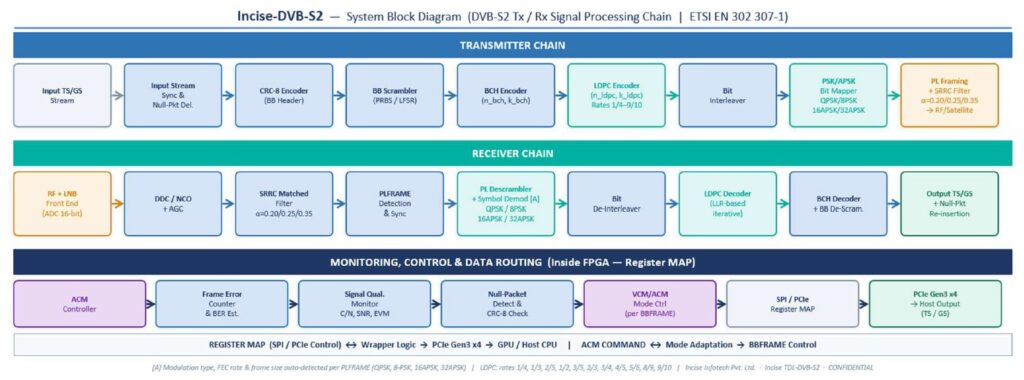
The DVB-S2 transmitter and receiver is an FPGA-based waveform implementing a fully compliant DVB-S2 Transmitter and Receiver chain per ETSI EN 302 307-1. The VHDL IP core is written in generic, synthesizable VHDL and is portable to any FPGA family. DVB-S2X (ETSI EN 302 307-2) extensions are supported as a future scope.
The transmitter and receiver designs are implemented on FPGA:
1. Transmitter (Tx): MPEG Transport Stream (188-byte) or Generic Stream
(GS) input → Input Stream Synchronizer & Null-Packet Deletion → CRC-8
(BB Header) → BB Scrambler (PRBS/LFSR) → BCH Outer Encoder → LDPC
Inner Encoder (rates 1/4–9/10, normal 64800-bit / short 16200-bit frame)
→ Bit Interleaver → QPSK/8PSK/16APSK/32APSK Bit Mapper → PL
Framing + Pilot Insertion → PL Scrambler → SRRC BB Filter
(α = 0.20/0.25/0.35) → IQ Modulation → RF/Satellite. Max payload: 858
Mbits/s (8PSK, rate 9/10, Kintex UltraScale+ -2).
2. Receiver (Rx): ADC 16-bit IQ baseband input (sampling at 2×fclk_RXg) →
DDC/NCO + AGC → SRRC Matched Filter (α = 0.20/0.25/0.35, user
programmable) → PLFRAME Detection & Sync → PL Descrambler → Auto
Symbol Demod (QPSK/8PSK/16APSK/32APSK — auto-detected per frame)
→ Bit De-Interleaver → LDPC Decoder (LLR-based iterative) → BCH Decoder
→ BB Descrambler → Null-Packet Re-insertion → Output TS/GS. Max
payload: >675 Mbits/s (8PSK, rate 9/10, Kintex UltraScale+ -2). FEC frame
type, modulation and encoding rate auto-detected on a frame-to-frame basis.
Key Features of the System:
Transmitter (Tx) /Encoder & Modulator Chain:
• Flexible per-BBFRAME programmable attributes — frame length (16200/64800 bits), FEC encoding rate and modulation type can change dynamically every BBFRAME for VCM/ACM operation
• Input stream flexibility — Single/Multiple MPEG Transport Streams (188-byte), Generic Stream packetized or continuous, with input synchronizer,
null-packet deletion and CRC-8 BB Header encoding
• Concatenated FEC — BCH outer code (n_bch, k_bch) + LDPC inner code (n_dpc, k_dpc); 11 code rates from 1/4 to 9/10; normal (64800-bit) and
short (16200-bit) frame support
• QPSK/8PSK/16APSK/32APSK Gray-coded bit mapping with PLFRAME Header (MODCOD field) signalling; dummy PLFRAME insertion for
continuous output
• PL Scrambler (BLER), Pilot Insertion (P=36 pilots per 1476-symbol period), SRRC BB filter (α =0.20/0.25/0.35) and quadrature modulation to 16-bit IQ DAC output
Applications:
• Satellite Communication Ground Terminals — DVB-S2 Tx/Rx for ISRO, HAL, DRDO satellite TTC & payload data links (Ku-/Ka-Band)
• DVB-S2 Broadcast — direct-to-home (DTH) uplink/downlink, IP-over satellite,
broadcast video distribution
• Military SATCOM — QPSK/8PSK for LPI tactical satellite links; ACM for adaptive margin management under fading
• High-Throughput Satellite (HTS) — 16APSK/32APSK for broadband data (858 Mbps peak at Kintex UltraScale+)
• SIGINT / COMINT — wideband DVB-S2 signal intercept, modulation classification and replay (DRDO, DEAL)
• DVB-S2X extensions (ETSI EN 302 307-2) — higher-order APSK, ultra-low CNR modes for future HTS deployments